The Staffing Paradox: Too Many or Too Few?
In today's competitive restaurant environment, finding the perfect staffing balance is like walking a tightrope. Overstaffing drains your profits, while understaffing damages customer experience and burns out your team. But what if you could predict exactly how many staff members you need, for each position, every hour of every day?
Predictive AI for staff scheduling doesn't just react to patterns—it anticipates them. By analyzing historical data alongside real-time factors like weather forecasts, local events, and even social media trends, AI-powered scheduling creates the optimal staffing plan that maximizes both service quality and labor efficiency.
Ali has spent 20+ years in hospitality operations.
Beyond the Crystal Ball: How Predictive AI Actually Works
Pattern Recognition
AI analyzes years of historical data to identify patterns in customer traffic, sales volume, and service demands across different days, times, seasons, and even weather conditions.
Multivariate Analysis
Unlike traditional forecasting, AI considers dozens of variables simultaneously—from local events and weather forecasts to social media sentiment and even competitor promotions.
Skill-Based Matching
AI doesn't just predict how many staff you need—it matches the right employees to the right shifts based on their skills, certifications, preferences, and performance data.

The Continuous Learning Loop
What truly sets predictive AI apart is its ability to continuously learn and improve. Each day's actual performance data is fed back into the system, allowing it to refine its predictions and become increasingly accurate over time.
Predictive accuracy typically improves as the model accumulates your own trading history.
Serving Up Success: Key Benefits of AI-Powered Scheduling
Cost Optimization
Reduce labor costs by 10-15% while maintaining or improving service levels through precise staffing aligned with actual demand.
Improved Employee Satisfaction
Create more stable and predictable schedules that respect employee preferences and work-life balance, reducing turnover by up to 25%.
Enhanced Customer Experience
Maintain optimal staffing levels during peak times to ensure prompt service, reducing wait times by 18-30%.
Management Time Savings
Reduce schedule creation time by 85-90%, allowing managers to focus on coaching staff and improving operations.
Compliance Assurance
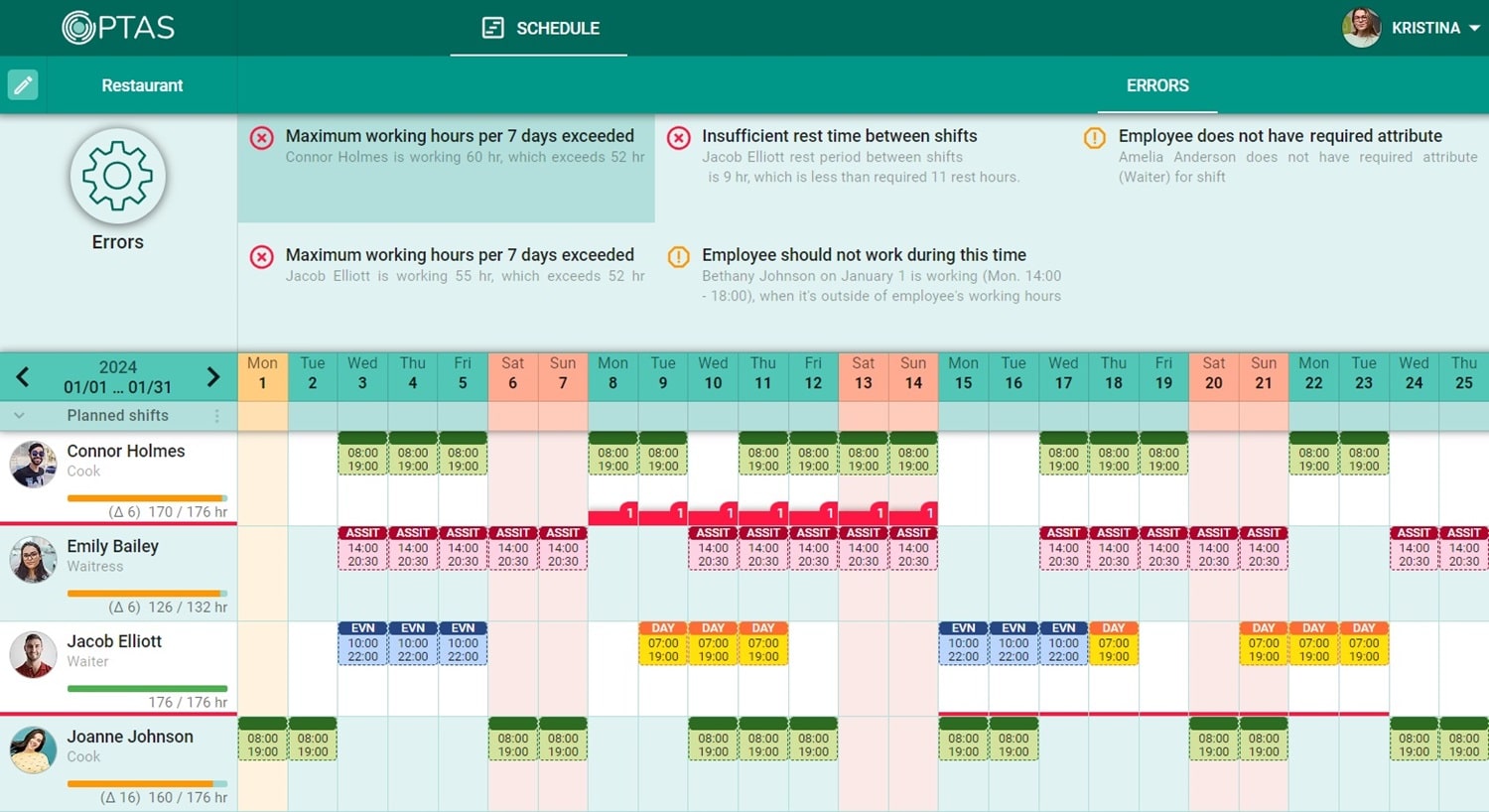
Automatically adhere to labor laws, break requirements, and overtime regulations, reducing compliance risks and potential fines.
Data-Driven Insights
Gain deeper understanding of staffing needs and operational patterns to inform business decisions beyond scheduling.
The Numbers That Matter: ROI Analysis
Typical ROI Timeline for a Mid-Size Restaurant (50-75 employees)
Average Annual ROI Breakdown
- Software Investment: $3,600-$7,200/year (dependent on restaurant size)
- Implementation Services: $2,000-$5,000 (one-time)
- Labor Cost Reduction: $30,000-$90,000/year
- Management Time Savings: $8,000-$15,000/year
- Reduced Turnover Savings: $10,000-$25,000/year
- Net Annual ROI: $33,000-$118,000
The Recipe for Success: Implementation Roadmap
Step 1: Foundation Assessment
Before implementing AI scheduling, we conduct a comprehensive analysis of your current operations:
- Audit of existing scheduling processes and challenges
- Historical data collection and preparation (minimum 6-12 months)
- Staff skills inventory and position requirement documentation
- Identification of unique business patterns and special considerations
Timeframe: 1-2 weeks
Step 2: System Configuration & Customization
We configure the AI scheduling system to match your specific restaurant needs:
- Position-specific staffing rules and requirements
- Integration with POS, reservation systems, and other data sources
- Custom algorithm parameters based on your business model
- Staff preference and availability management setup
Timeframe: 2-3 weeks
Step 3: Parallel Testing & Refinement
We run the AI scheduling alongside your existing process to validate and refine:
- Side-by-side comparison of AI vs. manual schedules
- Real-world testing of AI recommendations
- Algorithmic tuning based on results and feedback
- Staff and management training
Timeframe: 3-4 weeks
Step 4: Full Deployment & Continuous Improvement
We transition to the AI-driven system as the primary scheduling tool:
- Complete staff onboarding to new system
- Manager oversight and adjustment processes
- Monitoring and performance analysis
- Ongoing optimization and seasonal adjustments
Timeframe: Ongoing, with major improvements in first 3 months
The Epicurean Digital Consultants Difference
we bring a uniquely restaurant-focused approach to AI staff scheduling implementation. Unlike generic technology consultants, we combine deep hospitality experience with technical expertise.
Our Expertise
- Hospitality-specific AI implementation specialists
- Founder-led, with 20+ years in restaurant operations
- Data scientists specializing in labor optimization
- Change management experts focused on staff adoption
Our Approach
- Collaborative implementation that involves your entire team
- Human-centered technology adoption strategies
- Phased implementation to minimize operational disruption
- Continuous support and optimization post-launch
Traditional vs. AI-Powered Scheduling: A Comparison
| Feature | Traditional Scheduling | AI-Powered Scheduling |
|---|---|---|
| Forecasting Accuracy | 60-70% based on manager intuition and basic historical data | 90-97% using multi-variable prediction models and real-time data |
| Time Investment | 6-10 hours per week for management | 30-60 minutes per week for review and adjustments |
| Staff Satisfaction | Often inconsistent with last-minute changes | More stable with preference-based assignments and advance notice |
| Cost Control | Reactive adjustments after overspending occurs | Proactive optimization to prevent unnecessary labor costs |
| Compliance Management | Manual tracking with risk of errors | Automated rule enforcement and documentation |
| Adaptability | Slow to respond to unexpected changes | Real-time adjustments based on changing conditions |
| Employee Preferences | Limited consideration due to complexity | Comprehensive preference management that balances business needs |
| Long-term Planning | Typically week-to-week only | Capable of accurate long-range forecasting and planning |
Overcoming Implementation Challenges
Challenge: Staff Resistance
Employees may worry about algorithm-driven scheduling affecting their hours or preferences.
Solution
Involve staff early in the process, emphasize how their preferences are prioritized, and demonstrate how the system creates more fair and predictable schedules.
Challenge: Data Quality Issues
Missing or inconsistent historical data can impair AI forecasting accuracy.
Solution
we implement data hygiene processes and supplemental data sourcing to ensure the AI has quality inputs even when historical data is imperfect.
Challenge: Management Trust
Managers accustomed to handling scheduling may distrust AI recommendations.
Solution
We implement side-by-side comparison periods and progressive adoption, allowing managers to see the benefits firsthand and maintain override capabilities.
Challenge: Special Events Handling
One-off events and unusual situations can be difficult for AI to predict.
Solution
We develop custom event templates and an event management system that allows the AI to incorporate special occasions while learning from each one.
Is Your Restaurant Ready for AI Scheduling?
Rate your current situation on each of these factors to determine if AI scheduling would benefit your operation:
1. How much time does your management team spend on scheduling weekly?
- Less than 2 hours: Low potential impact
- 2-5 hours: Medium potential impact
- More than 5 hours: High potential impact
2. How predictable is your customer traffic?
- Highly predictable and stable: Lower immediate ROI
- Somewhat predictable with some variation: Medium ROI potential
- Highly variable and difficult to predict: Highest ROI potential
3. What is your current labor cost percentage?
- Under 25%: Potential for fine-tuning
- 25-30%: Good opportunity for optimization
- Over 30%: Significant optimization opportunity
4. How often do you experience staffing imbalances?
- Rarely (less than once a month): Lower immediate need
- Occasionally (a few times per month): Medium benefit potential
- Frequently (weekly or more): High urgency and benefit
5. What is your annual staff turnover rate?
- Under 50%: Good foundation for implementation
- 50-75%: Medium improvement opportunity
- Over 75%: Critical need and high potential impact
Analysis:
If you identified 3 or more areas with "High" potential impact, your restaurant is likely to see significant ROI from implementing AI scheduling. Even restaurants with 1-2 high-impact areas typically achieve meaningful improvements in efficiency and staff satisfaction.
Your AI Scheduling Quick-Start Checklist
Gather 6-12 months of historical data
Collect POS sales data, labor reports, weather records, and any event information from the past year to provide training data for the AI.
Document position requirements and skills
Create clear definitions of each role, required skills, and certification needs to enable precise matching of staff to positions.
Establish your labor targets by day-part
Define your labor cost goals for different meal periods and days of the week to guide the AI optimization process.
Update your staff information
Compile accurate data on employee availability, skills, certifications, and preferences to enable personalized scheduling.
Prepare your management team
Train managers on the new system and establish processes for schedule review and adjustment.
Communicate with your staff
Hold informational sessions to explain the new system, address concerns, and highlight the benefits for employees.
Plan your implementation timeline
Create a phased rollout schedule that minimizes disruption to your operations.